
Dr. Bhandari Sets World Record In Tele-Robotic Surgery
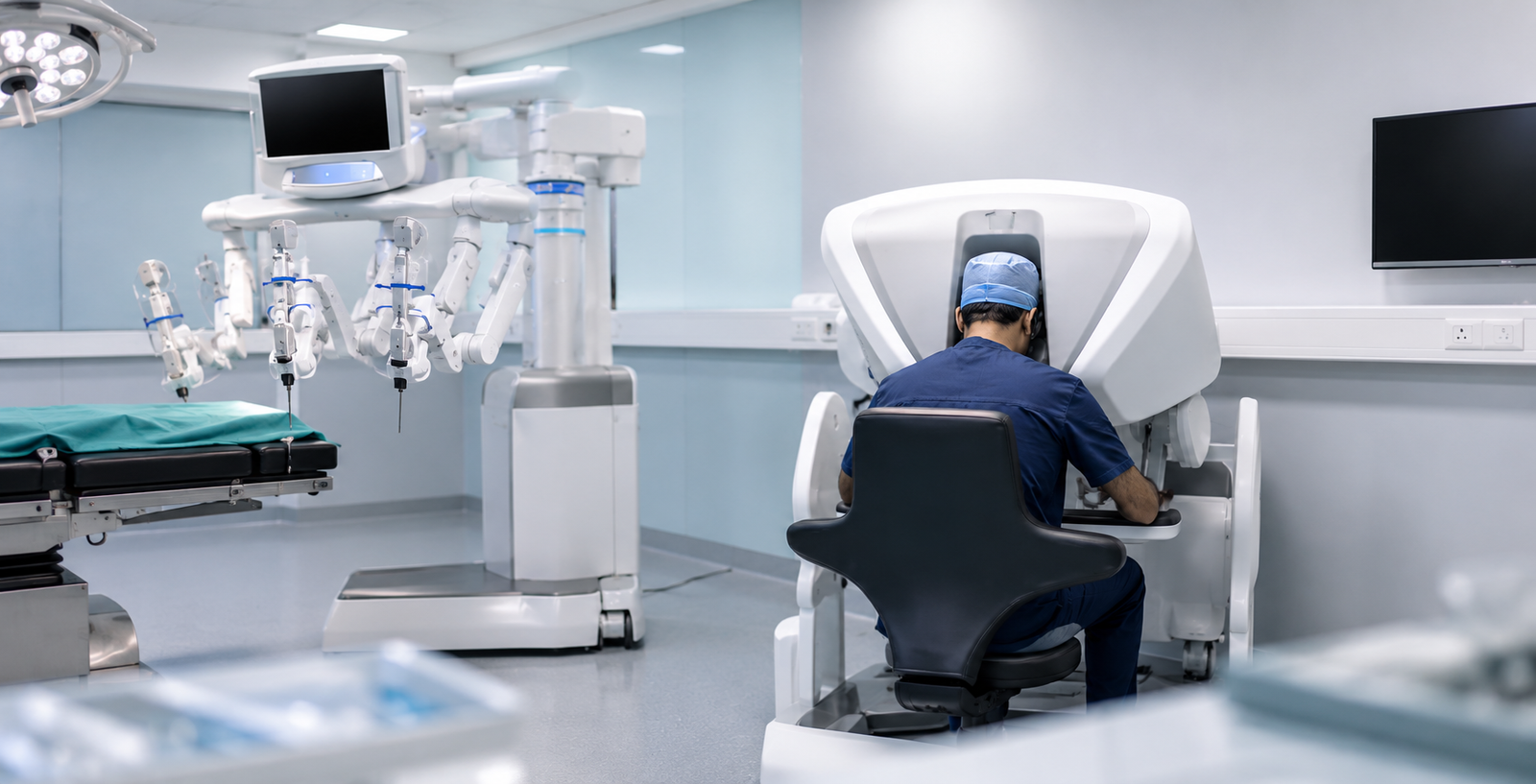
A surgeon sits down at a console in France. Ten patients are lying on operating tables nearly 10,000 kilometres away, in Indore, India. Over the next 10 to 11 hours, he operates on every single one of them. He never leaves his chair. He never feels a delay. And he never books a single flight.
That is not the opening sequence of a science-fiction script. That is exactly what happened in Indore on 7 July 2026. It is now a world record in tele-robotic surgery, officially logged as a World Book of Records entry. This transcontinental surgery milestone has permanently rewritten the rules of cross-border healthcare delivery.
Here is an inside look at how distance was rendered invisible, the technology that made it possible, and what this means for the future of global medicine.
How the World Record in Tele-Robotic Surgery Was Set
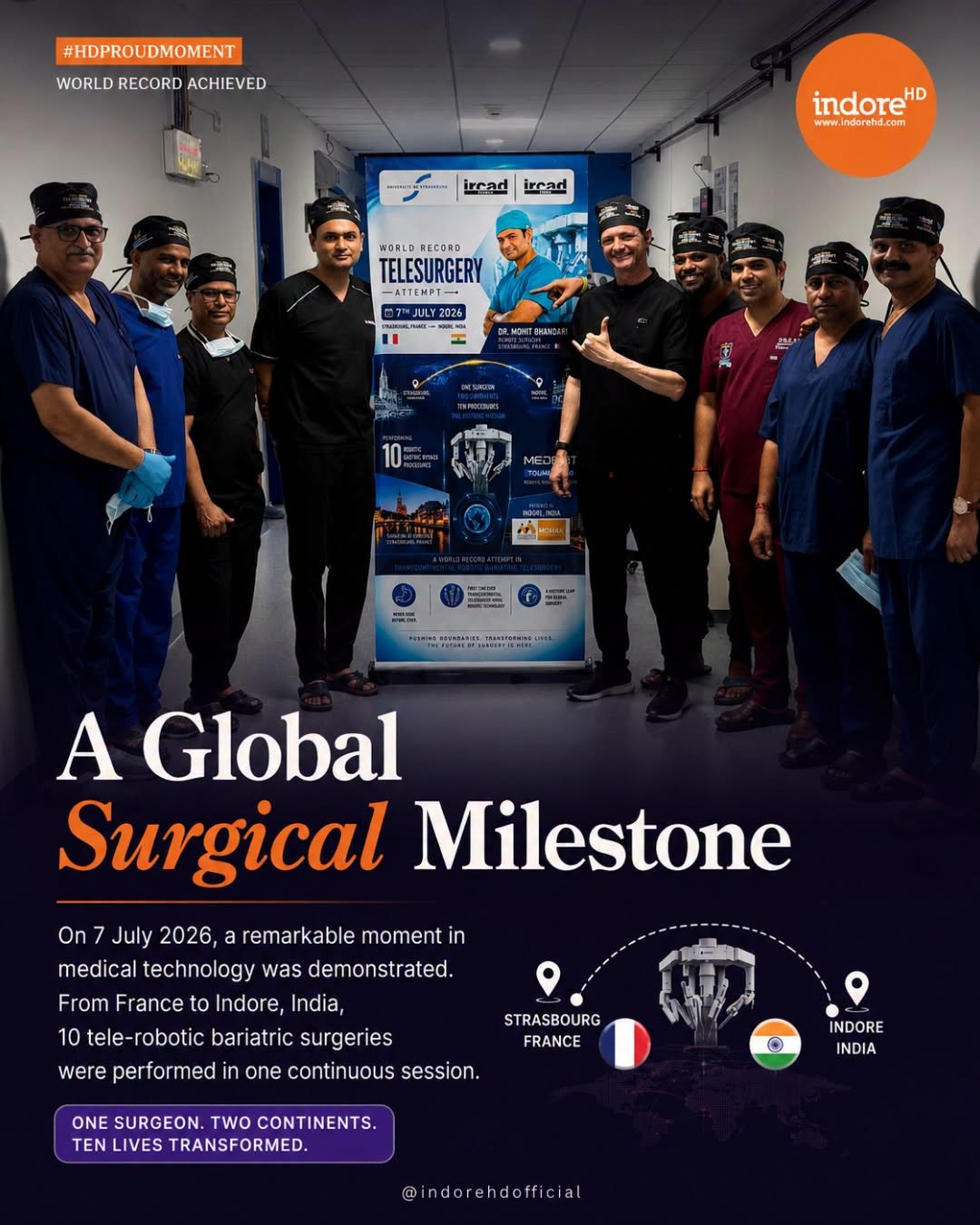
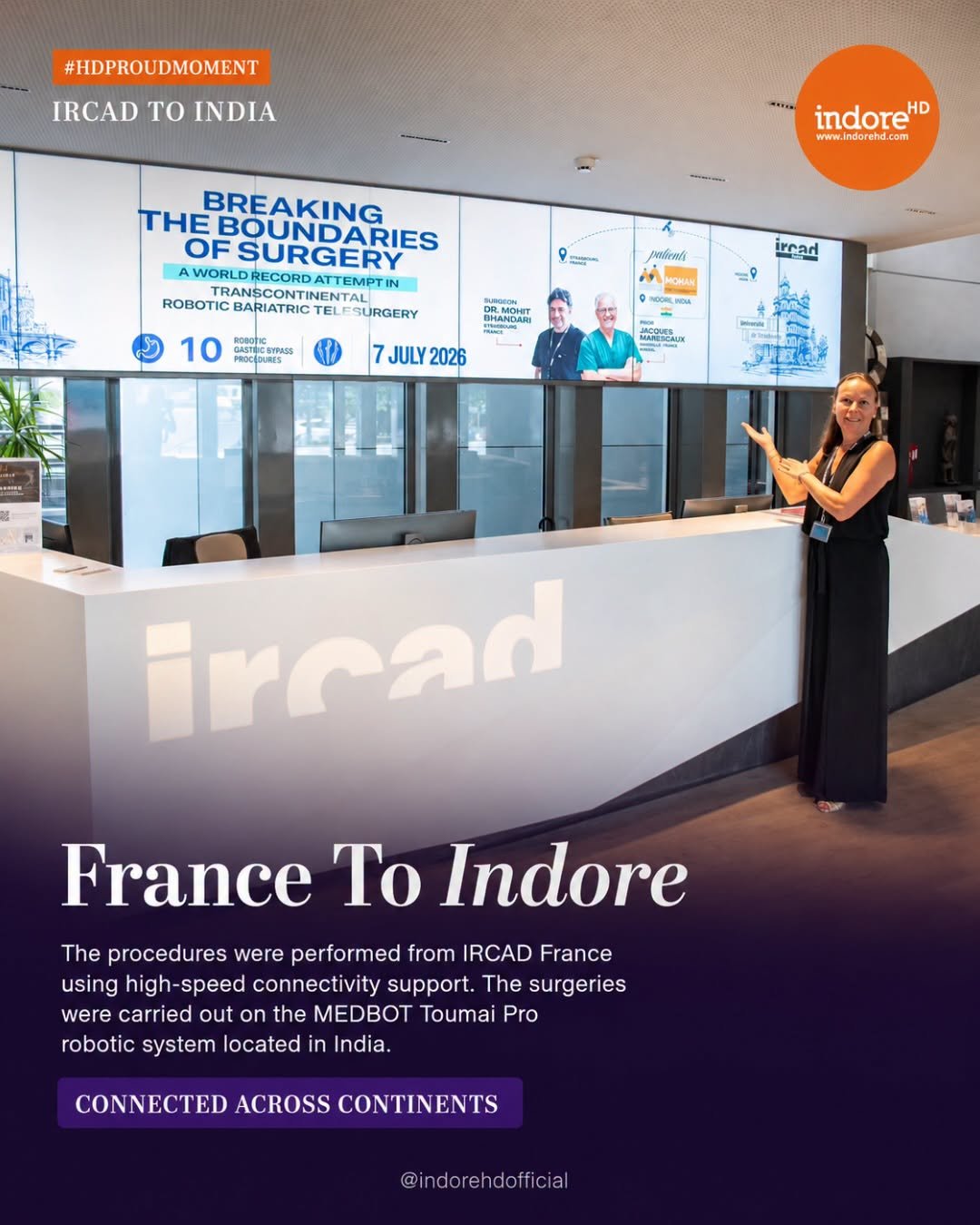
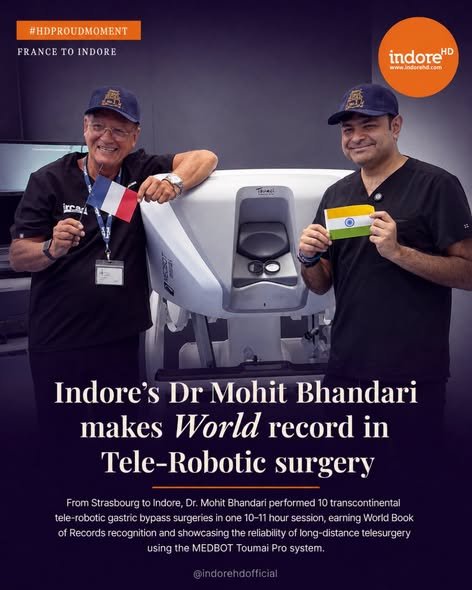
Dr. Mohit Bhandari is the President of IRCAD India and one of Asia’s most recognised names in bariatric and robotic surgery. On 7 July 2026, he took his seat at a surgical console inside IRCAD France, Strasbourg. His patients were not in the room next door. They were prepped and waiting inside IRCAD India, located in Indore. A high-speed data link connected the two sites, creating a zero latency surgical connection across continents.
Over the next 10 to 11 hours, Dr. Bhandari performed 10 transcontinental tele-robotic gastric bypass surgeries, back to back. In one continuous, uninterrupted session, he controlled every incision, suture, and tissue movement. He executed these remote bariatric procedures entirely on the MEDBOT Toumai Pro robotic system, operating from a different continent entirely.
Ten complex bariatric procedures. One surgeon. One sitting. Two countries. That unprecedented combination earned this surgical session its place in the World Book of Records. This wasn’t a single, heavily rehearsed flashy demo. Instead, it was ten real surgeries, done back to back, under real operating conditions, proving that long-distance medical care is a current reality, not a future concept.
From Limca to Transcontinental Surgery: The Surgeon Behind the Record
This isn’t Dr. Bhandari’s first world record, and that context is crucial for understanding the magnitude of this event. His career includes over 25,000 bariatric and metabolic surgeries. That sheer volume alone put him in the World Book of Records, long before telesurgery entered the mainstream conversation.
Back in 2015, Dr. Bhandari was already chasing endurance and precision records the old-fashioned way. He completed 25 bariatric surgeries in an 11-hour stretch, earning a spot in the Limca Book of Records. What has changed since then is the geography. The exact same surgical stamina that once meant a packed operating list in a single Indore hospital now stretches across continents. Today, the patient sits in one country, while the surgeon’s hands work, quite literally, in another.
That rich history is worth knowing because it reframes the 7 July session correctly. This wasn’t a surgeon trying a remote bariatric procedure for the first time under immense pressure. Instead, it was a decade of high-volume bariatric practice meeting a robotic platform built for extreme distances. That foundational expertise is precisely why the session held together flawlessly for ten full procedures, instead of falling apart after the first.

The Machine Powering Cross-Border Healthcare: MEDBOT Toumai Pro
None of this works without hardware engineered for exactly this high-stakes job. The MEDBOT Toumai Pro platform is a state-of-the-art, multi-arm robotic surgical system. It translates a surgeon’s exact hand movements, precisely and in real-time, onto surgical instruments that may sit thousands of kilometres away.
It runs on 5G-ready, hyper-secure connectivity and offers multiple robotic arms with a massive range of motion. Crucially, the system also includes real-time surgical smoke clearance. This vital feature keeps the surgeon’s 3D high-definition optical view sharp and unobstructed through every single step of the procedure.
Strip away the corporate branding, and you are left with a fairly simple idea. But that idea runs at a terrifyingly hard level of technical execution: making a 10,000-kilometre distance entirely invisible to a surgeon’s hands.
Beating Latency: The Stress Test of a Zero Latency Surgical Connection
Anyone who has ever been on a standard video call knows what a half-second audio lag does to a normal conversation. Now, imagine that exact same lag sitting between a surgeon’s hand and a scalpel-like instrument moving inside a patient’s abdomen. In the world of telesurgery, latency isn’t just a minor inconvenience—it is the entire risk.
For close to 10 hours and across nearly 10,000 kilometres, the digital and mechanical connection between Strasbourg and Indore held absolute firm. There was no meaningful lag, no dropped signal, and absolutely no loss of microscopic precision. Through ten separate, highly complex procedures, the network never faltered once.
That is the part of this story that matters even more than the world record itself. A single successful long-distance surgery can sometimes be chalked up to a lucky technological demo. Ten of them, executed flawlessly over a full working day, is a rigorous stress test that a mere “lucky demo” simply cannot pass.
Telesurgery Market Data: Why This Remote Bariatric Procedure is the Future
This milestone lands at an incredibly interesting moment for the global medical tech industry. Market research from Grand View Research pegs the global telesurgery market at close to $2.8 billion in 2025. Projections push that number past $8.8 billion by 2033, reflecting a massive growth rate of roughly 15% every single year.
Zoom out even further into the surgical robotics ecosystem. According to data from Towards Healthcare, experts expect the broader robotic surgery market to cross $16 billion in 2026 alone, with the potential to reach an astounding $60 billion-plus by 2035.
Numbers like that usually stay locked inside dry industry reports and investor pitch decks. What happened in Indore on 7 July 2026 is the living, human version of that exact chart. It is definitive proof, not just a financial projection. A specialist surgeon’s hands can now reach patients who would otherwise never have access to this tier of surgical expertise. The ocean between them simply no longer matters.
Indore’s Quiet Rise as a Global Med-Tech Hub
Here is the part locals should really sit up for: this isn’t Indore’s first time playing a starring role in this global narrative. The city’s IRCAD India campus previously hosted an earlier long-distance robotic telesurgery connecting Strasbourg to Indore. Now, this latest bariatric milestone adds a second transcontinental surgical record to that exact same France-India corridor. And this time, it involved ten procedures, not just one.
Indore is known nationally for its legendary street food trails and its consecutive number-one cleanliness rankings. Now, the city is quietly building a totally different reputation on the world stage: it is becoming a premier testing ground for the next generation of global surgery.
That is not a small shift. It fits perfectly into IndoreHD’s ongoing coverage of the city’s rapidly expanding med-tech scene. This is Indore showing up on a map that most of its own residents haven’t even thought to look at yet.
What Comes Next For Tele-Robotic Surgery
The honest takeaway from 7 July 2026 isn’t a cliché like “the future has arrived.” It is much narrower, and arguably much more useful. Telesurgery is officially moving past the conference-stage demonstration phase. It now looks exactly like ordinary, highly reliable clinical practice.
A single spectacular procedure won’t write the next chapter of medical history. Evidence, repetition, and grueling marathon sessions exactly like this one will write it instead. They will repeat again and again, bridging continents and saving lives, until the day nobody even calls them remarkable anymore.
Stay Ahead of Indore’s Biggest Stories
Indore is changing fast, and the world is taking notice. IndoreHD brings you every major update first. Subscribe to our platform for real-time city news, exclusive visual content, and the high-impact stories that matter most to Indore. Don’t just read the news—be the first to know it.
Follow @indorehdofficial on Instagram for daily city updates.